
Thinking about going solar? Before you start getting prices on a solar system, it pays to have a few facts straight so you don’t end up with a system that doesn’t suit your needs, or worse, pay too much.
Here are 9 beginner questions about buying solar in Australia you need answered first.. Read these, and you’ll be way ahead of most homeowners before you even ask for a quote.
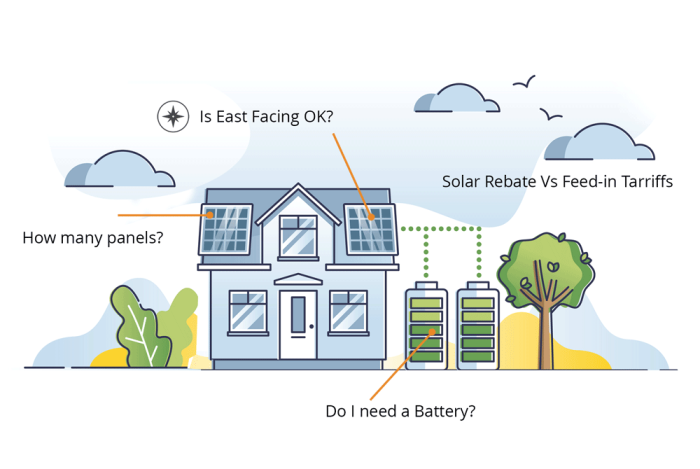
Most people undersize. They tell the installer their current bill is $250 a quarter, and the installer sizes it to cover just that. Big mistake.
Solar panels last 25 years, and your energy use won’t stay the same. You’ll likely buy an EV, install a pool, bigger air conditioning, etc. If you don’t install a battery, you’ll also need the extra kWh output to offset your nighttime power usage with fee-in tariffs.
A good rule of thumb: go a bit bigger than you think you need. It’s cheaper to install extra panels upfront than to try and “add on” later.
For a deeper breakdown of system sizing and how panel efficiency impacts it, see our guide to choosing the right solar system.
Batteries are the shiny object in solar right now. Everyone asks about them, and installers love selling them. But do you really need one from day one?
Short answer: it depends. Batteries give you backup in blackouts and let you use more of your own solar at night. But the payback period can still be 8–12 years (if your state has a battery rebate scheme that drops to 6 years), depending on the price you pay, your feed-in tariff, and how much energy you use after dark.
If your main goal is to cut bills fast, start with panels only. You can always add a battery later when prices drop, or when you’re ready for more energy independence.
See our Battery Basics 101 Guide for more on solar battery storage.

Nope. North-facing is best, but it’s not the only option. East and west-facing roofs still generate plenty of power — just at different times of the day.
East-facing panels will pump power in the morning. West-facing is perfect for late afternoon when you’re home cooking and running an air conditioner. Together, they can actually balance your usage better than north alone.
And if shading or poor angles are an issue, modern tech helps. Microinverters and optimisers mean one shaded panel won’t drag the whole system down.
Bottom line: don’t rule solar out just because your roof isn’t perfect.

This is a huge blind spot. You’ll hear numbers thrown around like “25-year warranty” — but that’s not the full story.
There are two types of warranties:
Product warranty → covers defects (typically 10–15 years for panels, 10 years for inverters).
Performance warranty → panels are guaranteed to still produce a percentage of their rated output after 25 years. Some degradation of panels over time is expected.
Installer craftsmanship warranty → This covers the installation and electrical work as well as the grid connection.
And then there’s who actually honours it. Product and performance is covered by the manufacturer of the panels, inverter or battery. Even if your installer goes bust and disappears tomorrow, the warranty is still valid with the manufacturer. Good brands have Australian offices or agents that handle claims, so you’re not chasing a company overseas.
Panels often last 25+ years, but most inverters will need replacing once in that time. Knowing this upfront stops nasty surprises.

This trips up everyone.
So the rebate makes your system cheaper on day one, while the FiT helps chip away at your bills month by month. Two different things.
Pro tip: Oversizing your system amplifies the feed-in tariff effect.
At least three.
One quote is a trap — you’ll have no idea if you’re being ripped off. Two quotes still leave you guessing. Compare 3 quotes to get a good range of panel brands, inverter models, system size, warranties, and price.
Most homeowners save thousands by just comparing a few different offers. And once you’ve got them side by side, it’s easy to spot the dodgy ones that cut corners.
This one catches a lot of people off guard. You sign up, excited to start saving, then nothing happens for weeks.
Here’s how it usually works in Australia:
Install day → most systems are fitted in 1–2 days.
Inspection and meter changeover → can add another week or two before your system is officially switched on. Good installers can do this themselves so no extra wait time.
Signing up for a FiT – Feed-in tariffs tie the whole deal together. Once the system is grid-connected, you can then switch to a plan to send power to the grid. Another 1-2 days.
So while the install itself is quick, the whole process can stretch to 4–6 weeks in some areas. Ask your installer up front so you know what to expect.
This is the big one. Solar has had its share of cowboys — door knockers, fly-by-night companies, or outfits that vanish as soon as something breaks.
Look for:
SAA (Solar Accreditation Australia) — non-negotiable in Australia, your installer needs to be accredited.
Reviews and reputation — Google, SolarQuotes, ProductReview.
Years in business — This is THE BIG ONE! Newer companies aren’t always bad, but 8+ years shows staying power. If you have an issue with the install or a question about a drop in power production a year or two after installation, you really need the company that installed the system. Another company won’t be interested.
Warranties in writing — and clarity on who honours them (installer or manufacturer).
If it feels rushed or pushy, walk away. A solid installer won’t pressure you — they’ll explain everything clearly and let you decide.
Solar is almost always a plus when selling. Studies show home values increase and sell quickly with solar installed, because buyers know their power bills will be lower.
The warranty usually transfers with the system. As long as you hand over the paperwork, the new owner can claim on it if needed.
Before you get quotes, get these 9 questions straight. They cover the big pitfalls that trip people up — system size, batteries, roof orientation, rebates, timelines, warranties, installer trust, and resale.
Once you’ve got the basics clear, you’ll be in a much stronger spot to compare offers and avoid being talked into the wrong system.
Compare 3 quotes from top-voted local installers and find the system that actually suits your home and budget.
