












 Reviewed by Bidhan Bhuson Roy
What can you get under the Sustainable Household Scheme?
The scheme offers funding for solar panels, battery storage systems, electric vehicle chargers, hot water systems, and other energy-efficient products from a list of eligible upgrades.
These sustainable upgrades are designed to improve your home’s energy efficiency and reduce your environmental impact while supporting the ACT’s net-zero emissions by 2045 target.

How much can you borrow through the scheme?
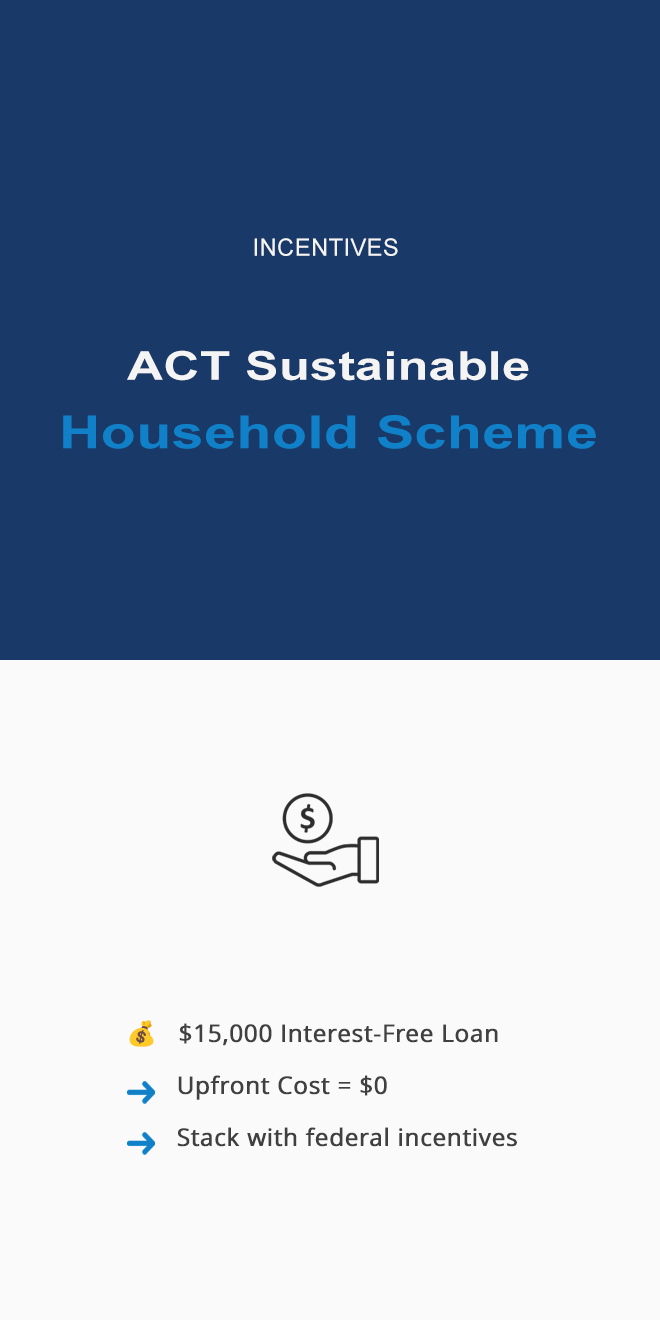
Eligible households may borrow between $2,000 and $15,000 through zero-interest loans under the scheme.
The funds borrowed can be used to install products from the list of eligible products, depending on approved quotes and lending criteria.
Is this scheme a rebate or a loan?
The ACT Sustainable Household Scheme is not a rebate — it provides an interest-free loan with no upfront costs or fees.
For information on ACT Solar Rebates, see our dedicated guide.
Unlike a rebate that reduces the purchase price, this program allows you to get a loan and repay the loan over time without an interest rate.
🔆Genius next move: Stack this with the federal government’s Cheaper Home Battery Program. Save 30% on the battery, then get an interest-free loan on it.
Also see the Next Gen Energy Storage Program for more discounts.
Who is eligible for the Sustainable Household Scheme?
Eligible ACT residents who meet eligibility criteria, including property requirements and lending criteria, may be eligible for the scheme.
Eligibility requirements may include:
- Meeting property unimproved value (UV) thresholds
- Being an eligible household in Canberra
What are the eligibility criteria for the scheme?
Eligibility criteria include property value limits based on unimproved value, residency requirements, and meeting the loan provider’s lending criteria.
You may be eligible if your property falls within the required UV of the property limits and you meet the eligibility requirements set by the ACT government.
How do repayments work under the scheme?
Repayment is made over time with structured repayment plans, typically with up to 10 years to repay the loan.
Because these are interest-free loans, repayments go entirely toward the system cost, helping improve affordability compared to traditional low-interest loan products.
How do you apply for the scheme?
You apply by submitting a loan application through an approved provider after receiving approved quotes for eligible products.
The process typically involves:
- Choosing products from the list of eligible upgrades
- Getting approved quotes
- Submitting a loan application and meeting lending criteria
Can you use the scheme for solar batteries?
Yes, battery storage and other storage systems are eligible products under the scheme.
Many households use the scheme to install battery storage alongside rooftop solar to increase energy efficiency and reduce reliance on grid electricity.
Can you use the scheme for electric vehicles or chargers?
Yes, electric vehicle chargers are included among eligible products in the scheme.
This allows households to improve energy efficiency choices by combining solar system generation with electric vehicle charging infrastructure.
Is the ACT Sustainable Household Scheme worth it?
The scheme is worth it for households looking to improve energy efficiency without paying high upfront costs.
It allows eligible households to access interest-free loan funding, reduce energy use and costs, and install solar products that support long-term savings.
How does the ACT scheme compare to other state incentives?
The ACT government uses zero-interest loans instead of a direct rebate, unlike other states.
This approach focuses on improving affordability through repayment flexibility rather than reducing the upfront price, which can suit households managing cash flow.
Where does the scheme fit in your solar setup?
The scheme works alongside federal solar rebate programs and helps households finance remaining system costs.
In most cases:
- Solar panels reduce electricity bills
- Battery storage increases self-consumption
- The scheme spreads upfront costs over time
