













Home Sunshine Coast Solar Panels
Sunshine Coast Solar Panels – 2026 Cost & Rebate Guide
 Reviewed by Leigh McInerney
Solar energy systems across the Sunshine Coast and throughout QLD vary in terms of design and pricing. Opting for solar energy allows you to calculate your Small-scale Technology Certificates (STCs) and pursue your rebate. Usually, the quote you receive for installation has already factored in the governmental rebate. Moreover, it’s wise to seek out the best feed-in tariff that matches the scale of your solar system.
In Sunshine Coast, a 5kW solar system goes for about $5,453, while the average price in Brisbane for the same size is about $5,692. This price is inclusive of the government rebate. For this size of the solar system, you will get a government rebate of $1,596 in Sunshine Coast.
With the government rebate and your incentives from the FiT system, you can significantly reduce your system’s payback time. A 5kW solar produces an average output of 27.0kWh and has a return on investment period of 3-5 years.
Table of contents
Solar Panels Cost Sunshine Coast
| Service/ system | Size | Cost |
|---|---|---|
| Solar cost per KW Sunshine Coast | 1 kW | $1,832 |
| National average cost per KW | 1 kW | $1,892 |
| 3kW solar cost Sunshine Coast | 3 kW | $3,858 |
| 5kW solar cost Sunshine Coast | 5 kW | $5,453 |
| 6.6kW solar cost Sunshine Coast | 6.6 kW | $6,684 |
Government solar panel rebate in QLD

If you live in QLD, you can receive a solar rebate from the Australian government. Therefore, any solar system you buy qualifies you for a rebate as long as the Clean Energy Council approves it. Also, a CEC-accredited installer must do the installation.
The solar rebate in QLD can reduce your system’s cost by up to a third of its cost. For instance, the cross-section cost of a 5kW system is $7,049. For this size, you can get a government rebate of $1,596. This brings the net system cost to approximately $5,453.
The rebate you receive from your government depends on your solar system’s size and location in Queensland. You can calculate the STCs in your zone to know the rebate you get for your solar system’s size.
For instance, a 5kW solar gets 40 STCs and costs approximately $7,049. This system receives a rebate of $1,596 in QLD, while a 6kW solar system gets 48 STCs, costs about $8,314, and earns a rebate of $1,915.
| System Size | Rebate Amount |
|---|---|
| 2kW | $638 |
| 3kW | $958 |
| 4kW | $1,277 |
| 5kW | $1,596 |
| 6kW | $1,915 |
| 10kW | $3,232 |
Solar system output in Sunshine Coast QLD
Below is an illustration of the solar panels’ output on the Sunshine Coast.
| System Size | Output |
|---|---|
| 1kW | 4.3kWh |
| 1.5kW | 6.45 kWh |
| 2kW | 8.6 kWh |
| 3kW | 12.9 kWh |
| 4kW | 17.2 kWh |
| 5kW | 21.5 kWh |
| 6kW | 25.24 kWh |
| 10kW | 38.5kWh |
Solar Feed-in tariffs QLD
The right feed-in tariff helps you save your surplus energy to avoid wasting even a single kW. So, it is essential to choose the best FiT to get the best rewards. If you are looking for a reliable FiT, the following three recommendations will be of help.
Diamond Energy
Best Overall

| Min FiT | Max FiT |
|---|---|
| 12.0c | 12.0c |
With Diamond energy, you can get up to 12.0c per kW. This means that every kW will be accounted for, and no energy will go to waste. This company offers the highest quality in rates, and it is very transparent.
You will not worry about any contracts with this company because it does not offer any lock-in contracts. It is, therefore, a great option as you can move any time you want.
Runner up

| Min FiT | Max FiT |
|---|---|
| 15.0c | 59.0c |
Red Energy is another reliable company that offers 15.0c per kW. The FiTs can go up to 59.0c depending on your solar system. With this company, you are assured of transparency as you will receive every cent for your energy.
Red energy ensures no power goes to wastes and encourages people to go green. It is a great company to consider for your FiTs.
Great All-rounder

| Min FiT | Max FiT |
|---|---|
| 12.0c | 56.0c |
Click Energy is yet another company that offers top-notch services to its clients. This company awards 12.0c per kW and it can go up to 56.0c per kW. This rate is promising and can help you save up for your solar.
With Click Energy, all your excess energy translates into money. This company is transparent and very reliable as well.
Is Sunshine Coast a good climate for solar?
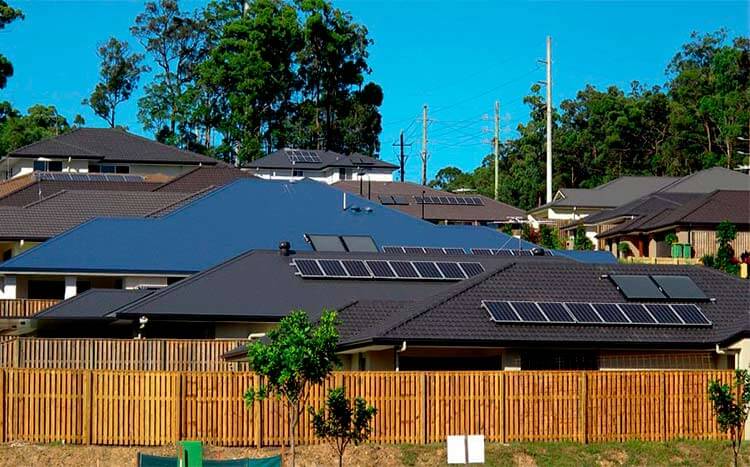
Sunshine Coast is among the highest sunshine ratings in Australia. It is in zone one, which is considered the sunniest zone in the whole of Australia. Therefore, the solar system in this region will produce a high amount of electricity. It has sunny summers with an average of 28.6 degrees and sunny winters with an average temperature of 21.3 degrees. So, Sunshine Coast has a good climate for solar.
Percentage of Sun Coast households with solar installed
About 30% of homes on the Sunshine Coast have installed solar systems. This translates into approximately 40,000 installations so far. This is one of the best regions to install solar energy in Australia.
Optimal solar panel orientation and angle in Sunshine Coast
Your roof’s slope provides the best angle to install solar panels. However, for a flat roof, the best tilt angle is about 26.6 degrees on the Sunshine Coast. Because we are in the southern hemisphere the best orientation or panels is true north. Your installer should ensure that the panels are at the best angle for optimal sunshine absorption and for self-cleaning when it rains.
FAQs
Do solar panels store energy?
Yes, solar panels store energy through batteries. The batteries store all the energy harnessed by your system to use later. The batteries come with their own inverters that convert the solar energy into electricity. So, when the panels are not producing energy, you can draw power stored by your batteries.
Will I be “off the grid” with solar panels?
This will depend on how much sunlight you receive in the region you live in and the size of the system you have. Generally, most solar systems do not produce enough power to support all your household needs. That is why most homeowners who have installed solar systems remain in contact with their utility companies.
How long do solar panels last?
Solar systems have a lifespan of 25 to 30 years, according to the industry standard. The system loses its efficiency gradually. For the first ten years, it loses 10% of its efficiency. By 20 to 30 years, it loses about 20%, which means you should consider upgrading the system by the time it reaches 40 years.
Do they come with a warranty?
Typically, most panels come with a linear performance warranty of 20 to 30 years to ensure the system maintains the production capability. The system also comes with a product warranty to protect you from costs that may come up in case of defects or poor installations. The product warranty period depends on your installer.
